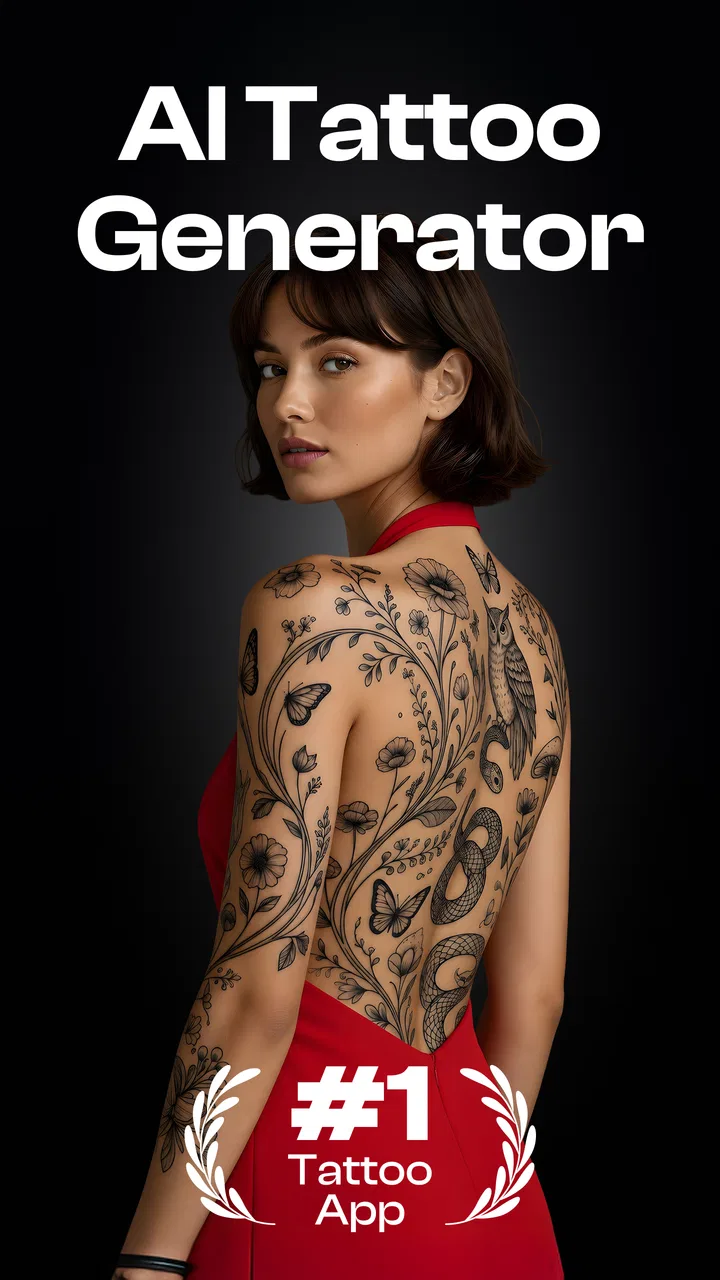
Tattooist: AI Tattoo Generator
- 3.7
- Rating
- 500.00K
- Installs
- Free
- Price

 Analysis by App-foxy
I tried Tattooist: AI Tattoo Generator as the kind of app you might open with another person nearby: one of you has an idea for a tattoo, while the other wants to turn that rough thought into something easier to discuss. It belongs to the Art & Design category, and its focus is clear from the moment you use it: creating tattoo concepts and preparing stencil-style artwork rather than serving as a complete drawing studio. I found it most useful as a conversation tool between an idea and a tattoo artist, not as a replacement for professional design work or an appointment.
The app is free to install, which makes it easy to test before deciding whether it fits your routine. It is made by MAETCH EXPANSION, S.L., carries an Everyone content rating, and has reached over 100 thousand installs. Its average rating is 4.1 from around 1 thousand ratings, with roughly 109 written reviews, so there is enough public use behind it to make the app feel established without suggesting that it will suit every creative style.
Using Tattooist together on a shared phone or tablet
When I use Tattooist on a shared phone or tablet, I treat the session as brainstorming rather than a group vote on someone else’s tattoo. It helps to agree whose idea you’re exploring and what kind of feedback they want before comparing concepts; that keeps playful suggestions from becoming accidental decisions. I’d also set aside a moment to review which images are worth keeping, so the next session starts with a clearer direction.
You May Also Like

 Blood Strike: 2.5 Anniversary
Blood Strike’s Loadouts Turn Every Drop Into a Tactical Gamble
A close look at Blood Strike’s custom loadouts: how fast access to signature weapons reshapes its battle royale rhythm, rewards preparation, and narrows the gap between fights.

 Pandora - Music & Podcasts
Pandora’s Music Is Easy to Start, but Harder to Recover
Pandora’s strength is its low-effort path from a seed to a station. Its weak spot is how much confidence it asks you to place in connection, setup, and quiet recovery.

 8 Ball Pool
 Is Built on Rivalries, Rematches, and Routine
A close look at the rivalries, rematches, shared routines, and unanswered safety questions that turn a quick pool match into a persistent mobile community.

 Samsung Music
’s Quiet Strength Is Playing What You Already Own
Its reach comes less from spectacle than from dependable access to a personal library. That simplicity is both the app’s strongest retention engine and its ceiling.

 AccuWeather: Weather Radar
AccuWeather Review: A Quick, Clear Forecast for Everyday Decisions
For everyday plans, the best forecast is the one you can understand quickly. AccuWeather makes rain timing, radar, and local conditions easy to act on, with a few trade-offs.

 Hill Climb Racing
Why Hill Climb Racing Still Turns Crashes Into One More Run
A tiny car, a bumpy hill and one more upgrade: Hill Climb Racing keeps resurfacing because its simple chaos makes every near-miss feel personal.
More From Our News Desk
View All News


A practical household scenario
The most convincing use case for me was a shared design session. Imagine two people at home planning a small matching tattoo, a pet tribute, or a symbol connected to a trip. Instead of searching through unrelated images and trying to explain what feels right, you can sit together, describe the direction you want, and compare several visual ideas on the same device. That changes the app from a solitary generator into a useful starting point for a decision.
One person may care about the meaning, while the other is thinking about line weight, placement, or whether the design will still look good when reduced. Tattooist helps put those different concerns on the same screen. I would use it during the early stage, before contacting a tattooist, because it gives both people something concrete to react to. “I want something delicate” is vague; a few contrasting concepts make it easier to say what should be removed, enlarged, simplified, or moved.
There is also value in using it with a friend who has a stronger visual sense. A shared device lets one person enter the initial idea and the other notice problems that the original creator may overlook. A design that looks attractive as a centered image can feel too dense for a wrist, too wide for an ankle, or too detailed for a small placement. The app cannot settle those professional questions by itself, but it can expose them early enough to improve the conversation.
Why the stencil angle matters
Many image-generation tools are good at producing attractive pictures but less helpful when the goal is tattoo planning. Tattooist’s stencil-oriented purpose gives the output a more practical direction. I found myself judging designs less as finished illustrations and more as references: where the main shape sits, whether the silhouette reads clearly, and which details might need to disappear before the work reaches skin.
That distinction is important when several people are collaborating. A dramatic, highly decorated image may impress everyone for a few seconds, yet it may not translate well to a tattoo. A simpler concept can be more useful because it gives a professional artist room to redraw it properly. My advice is to treat the generated result as a brief for the tattooist. Save the parts that communicate the idea, then discuss what must be adapted for size, body movement, aging, and the artist’s technique.
Keeping the session organized without pretending it is a family tool
On a shared device, I would keep each person’s concepts in clearly named groups outside the app if the operating system offers a suitable way to organize images. For example, separate a child’s playful sketch ideas from an adult’s serious tattoo references, or distinguish “matching symbols” from “future appointment.” This is not a special household feature of Tattooist; it is simply a sensible workflow when multiple people use one screen.
I also recommend deciding who is responsible for the final selection. Shared brainstorming works well, but a tattoo is still a personal and permanent choice. If everyone edits or judges every concept, the session can drift toward the safest design rather than the most meaningful one. I get better results when one person explains the purpose, another offers criticism, and the final owner decides what deserves to be taken to a professional.
What setup feels comfortable for different users
The app is straightforward to approach because the basic idea does not require previous drawing experience. Someone who has never used a design program can still participate by describing a subject, style, or mood. That makes it more welcoming than a traditional illustration app, where blank canvases, brushes, layers, and technical controls can put a casual user off immediately.
At the same time, I would not hand it to a household member expecting a full explanation of tattoo technique. The app can help visualize an idea, but it does not turn an inexperienced user into a tattoo designer. A beginner should use it to compare directions, not to decide that a generated picture is ready to transfer directly to skin.
For an adult sharing a phone with others, a small boundary is worth setting before the session: decide whether the device is being used for experimentation or for saving a serious reference. That sounds obvious, but it prevents a playful design made by one person from being mistaken later for the final choice of another. Clear labels and a short discussion are more reliable than assuming everyone understands the same image in the same way.
Coordinating ideas before speaking to a tattoo artist
The strongest workflow I found is to begin with a written brief, even if it is only a few sentences. Include the subject, the feeling you want, the approximate placement, and the details you definitely do not want. Then generate or explore concepts with that brief in mind. This reduces the temptation to choose the most eye-catching result simply because it appeared first.
When two people are involved, compare designs using the same questions. Does the central shape remain recognizable at a glance? Is the design too crowded for the intended area? Would it still communicate the idea if the smallest marks were removed? Does it look like something the owner would enjoy years from now, rather than merely something that matches today’s trend? These questions turn a casual session into useful preparation.
A particularly helpful trick is to make one deliberately simpler version after finding a favorite. Remove decorative elements and compare the two side by side. The simpler version often reveals whether the emotional core is strong enough without visual noise. This is one of the app’s better household uses: it encourages discussion about what matters instead of letting everyone argue over surface style.
Once a direction is chosen, I would send the concept to a tattoo artist as reference material and ask for a professional redraw. The artist can assess whether the design fits the body area, whether the lines need more separation, and whether the composition will age well. Tattooist makes that first conversation easier, but it should not be the last design checkpoint.
Age, trust, and responsible use
The Everyone rating makes the app approachable in a household where younger users may encounter it, but an age label should not be confused with permission to get tattooed. A child can use the app for character art, temporary tattoo ideas, or a design exercise while an adult keeps the permanent decision separate. I would make that distinction explicit, especially if several people use the same device.
There is a trust issue with any creative app used by more than one person: who created an image, who approved it, and who is allowed to share it outside the household? Tattooist can support collaboration, but it does not remove the need for ordinary communication. I would avoid presenting a generated concept as if it were already approved by a partner, parent, friend, or tattoo artist.
For a teenager interested in tattoo culture, the app can be a constructive way to explore symbolism and composition without immediately committing to ink. An adult can ask the teenager to explain the meaning, placement, and long-term appeal of each idea. That conversation is more valuable than simply approving or rejecting a picture. The app gives both sides a visual object to discuss, while the final decision remains a separate responsibility.
I would also be careful with shared galleries or casual messaging. A design made for one person may contain a name, date, or symbol that another household member does not want circulated. The safest habit is to review an image before sharing it and to keep personal concepts distinct from general experiments. This is basic digital etiquette, but it matters more when a creative idea is tied to identity or a permanent body decision.
Where it compares well with ordinary alternatives
The usual alternative is a general image search. That is faster for collecting inspiration, but it often produces finished tattoos without explaining how to adapt them. Tattooist is more useful when you want to shape an original direction rather than browse an enormous pile of existing work. It also keeps the session focused on tattoo-related composition instead of making you translate unrelated artwork into something suitable for skin.
Another alternative is a drawing app. A capable drawing program gives a skilled user more control over layers, brushes, curves, and cleanup. If you already know how to sketch and want exact control over every line, that route is better. Tattooist has the advantage for people who have an idea but lack the confidence or time to draw it from a blank canvas. Its trade-off is that you are working from generated concepts rather than building every mark yourself.
You could also ask a professional tattoo artist to develop the idea from the beginning. That remains the better choice when placement, anatomy, realism, lettering, or technical longevity is central. The app is most valuable before that appointment, when you need to clarify your taste and communicate a starting point. It can save explanation time, but it cannot replace the artist’s judgment.
Limits I noticed before recommending it
The first limitation is expectation. A generated concept can look polished while still being unsuitable as a tattoo. Fine details may be too close together, lettering may need correction, and an image that works on a screen may not work at the chosen size. Anyone who treats the output as production-ready is likely to be disappointed. I would recommend it only with the understanding that revision is part of the process.
The second limitation is creative specificity. If you have a very exact visual language, a professional illustrator or tattooist may reach the target more directly. Tattooist is better at opening possibilities and testing broad directions than guaranteeing a precise personal style on the first attempt. I enjoyed that exploratory quality, but I would not rely on it for a design where every proportion has already been decided.
There is also a cost boundary to keep in mind. The app is free, while its in-app purchases range from $6.99 to $39.99 per item. That makes trying the basic experience relatively low-risk, but I would not pay for extras until I knew they solved a real problem in my workflow. For a one-time tattoo idea, free experimentation may be enough; for repeated design work, the value depends on how often you return and how much the additional options improve your results.
The current version is 1.9.0, and the minimum operating system is Android 10. That is worth checking before installing on an older shared device. In a household, compatibility can become an unexpected issue when one person uses a newer phone and another relies on an older tablet. I would test the app on the device that will actually host the design session rather than assuming every family screen will be suitable.
Who should use it, and who should skip it
I would recommend Tattooist to someone who has a vague tattoo idea and wants visual prompts, to friends planning coordinated designs, and to households where a younger person wants to explore tattoo-inspired art without making a permanent commitment. It is also useful for an adult who wants to arrive at a tattoo consultation with several clear directions instead of a single poorly explained reference.
I would skip it if you need exact vector control, professional lettering, detailed anatomical planning, or a final stencil that can be used without revision. I would also skip it if you are looking only for a gallery of existing tattoos. A specialist portfolio site or direct conversation with an artist will serve those needs better. The app earns its place in the process when uncertainty is the problem.
My household verdict
After using it as a shared creative aid, I see Tattooist: AI Tattoo Generator as a convenient bridge between conversation and consultation. Its best quality is not that it magically finishes a tattoo; it is that it gives people a faster way to compare ideas, explain preferences, and notice when a design needs simplifying. That makes it especially practical when two or more people are trying to coordinate without losing sight of who will ultimately wear the tattoo.
I like that the free entry point lowers the barrier to experimentation, and the Everyone rating makes it easy to introduce in a mixed-age household with sensible adult guidance. Still, trust and boundaries have to come from the people using the device. There is no substitute for deciding whose design is whose, what can be shared, and when a professional should take over.
My final recommendation is to use the app in three passes: explore several directions, reduce the favorite to its essential shapes, and take that reference to a qualified tattoo artist for review. If you follow that workflow, Tattooist can be genuinely helpful without encouraging unrealistic expectations. For casual household brainstorming and early-stage tattoo planning, I would keep it installed; for final artwork, I would hand the project to a human specialist.
FAQs for Tattooist: AI Tattoo Generator
01What is Tattooist: AI Tattoo Generator?
Tattooist: AI Tattoo Generator is an innovative app designed to help users create unique tattoo designs using artificial intelligence. It allows users to explore a wide range of styles and generate personalized tattoos based on their preferences. The app is available for both Android and iOS platforms.
02How does the AI feature work in Tattooist: AI Tattoo Generator?
The AI feature in Tattooist analyzes user inputs, such as preferred style, size, and themes, to generate custom tattoo designs. It uses advanced algorithms to combine various design elements, ensuring each tattoo is original and tailored to the user’s specifications. This feature provides an intuitive and interactive design experience.
03Is Tattooist: AI Tattoo Generator free to use?
Tattooist offers a free version with basic features and access to a limited number of designs. However, for a more extensive library and advanced customization options, users may need to purchase a premium subscription. This allows the app to provide enhanced services and support continuous development.
04Can I save and share my tattoo designs from the app?
Yes, Tattooist allows users to save their creations directly to their device's gallery. Additionally, designs can be easily shared with friends or professional tattoo artists via social media or messaging apps. This feature ensures that users can keep and communicate their ideas efficiently.
05Is Tattooist: AI Tattoo Generator suitable for professional tattoo artists?
Tattooist can be a valuable tool for professional artists seeking inspiration or wanting to offer clients a broader range of options. While it’s not a substitute for professional skill, the app can complement the creative process by providing fresh ideas and facilitating client-artist communication.
Pros
- Easy-to-use interface for all skill levels.
- Generates unique tattoo designs quickly.
- Wide variety of styles to choose from.
- Allows customization for personalized results.
- Supports high-resolution outputs for clarity.
Cons
- Limited free features without subscription.
- Occasional glitches in design generation.
- Requires internet connection for full access.
- Some designs may lack originality.
- Ads can be intrusive in the free version.

Tattooist: AI Tattoo Generator
Gallery